
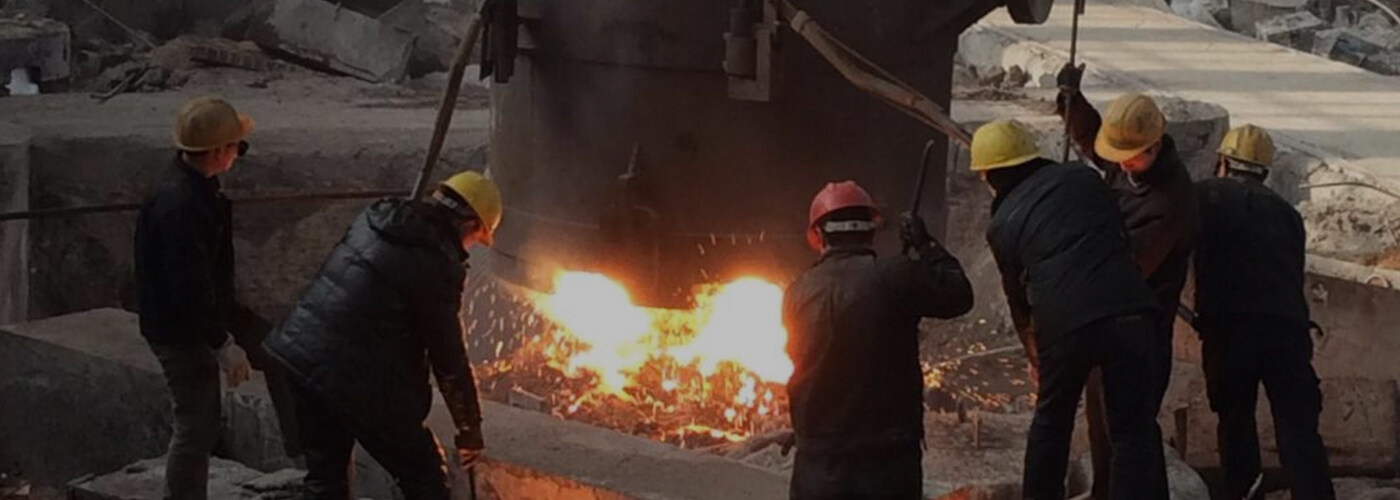
As-cast workpieces straight from pouring come with inherent metallurgical and mechanical drawbacks: severe casting residual stress, coarse uneven grains, brittle chill structures, unstable dimensions, low toughness and poor cutting machinability. If these defects remain unaddressed, cast components are prone to warping during machining, edge chipping in cutting operations, brittle fracture under service load, and short service life. Heat-treatment furnaces are purpose-deployed to resolve these casting-derived problems and achieve reliable final component performance.
Castings are placed inside the heat-treatment furnace to carry out annealing, normalizing, quenching-and-tempering, carburizing-nitriding or Hadfield-steel water-toughening. Through accurately controlled heating, holding and cooling cycles within the sealed furnace chamber, solidification-generated residual stress is fully relieved; coarse as-cast grains are refined; harmful brittle chill structures are eliminated; hardness-to-toughness ratios are properly balanced; workpiece dimensional stability is greatly improved.
By means of furnace heat treatment, manufacturers solve frequent practical production issues: casting deformation after machining, part cracking under assembly or operating loads, excessive tool wear and poor surface finish during cutting processes. These furnaces process steel castings of carbon steel, low-alloy steel, stainless steel, Hadfield steel, heat-resistant steel and corrosion-resistant steel, making cast parts qualified for subsequent machining and real-world service.

Copyright © Henan Tianli Thermal Equipment Co., Ltd. Power by yisainuo
